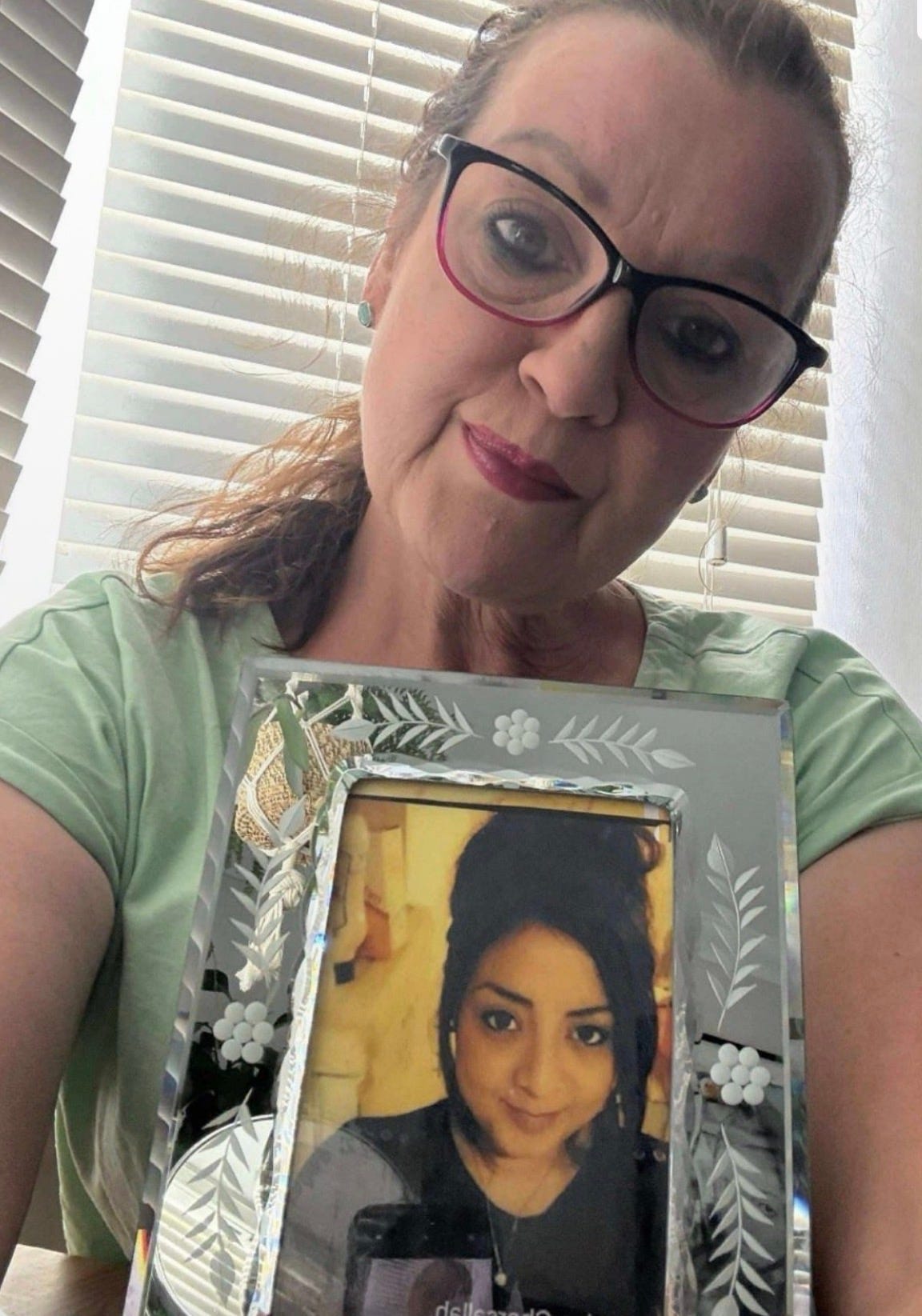
When the System Struggles: Georgina Gharsallah, Her Family, and Charlie Hedges on Missing Persons Investigations

On the morning of 7 March 2018, Georgina Gharsallah left her home in Worthing, heading into what appeared to be a normal day. Within hours, she vanished.
At 11:30 a.m., her mobile phone connected to a nearby mast for the last time. After that, there was no trace—no bank activity, no confirmed sightings, no explanation. Eight years later, her disappearance continues to cast a shadow over her family.
Her mother, Andrea Gharsallah, remembers the sense of helplessness immediately. “We were always Georgina’s one constant,” she says. “She wouldn’t just walk away without telling us. Not knowing what happened to her is torture.
The Last Known Movements
Georgina, 30 at the time, lived with her mother and was raising two young children. Friends and family describe her as fiercely protective of her family, someone who balanced personal struggles, including anxiety and periods of disordered eating, with a devotion to her children.
“She adored them,” Andrea says. “Everything revolved around them.”
That Wednesday began like any other. Around 9:30 a.m., Georgina told her mother her phone wasn’t working and planned to visit a repair shop before stopping at the Jobcentre and meeting her father later. CCTV captured her entering Clifton Food and Wine shortly before 10 a.m., where the shopkeeper directed her to a nearby specialist for phone repairs.
Roughly ninety minutes later, her phone pinged a local mast for the final time. After that, the digital trail vanished. Initially, Andrea assumed Georgina might be staying with friends or her former partner, but her absence from her children’s lives quickly raised alarm. “She would never have gone days without arranging something for them,” Andrea says. “That’s when I knew something was terribly wrong.” Ten days later, she was reported missing.
Questions About the Early Investigation
The initial handling of Georgina’s disappearance has been a source of frustration for the family. Some CCTV footage arrived late or was reportedly lost, and a potential sighting later that day of two women walking together was never fully resolved.
“The first hours are the most important,” Andrea says. “Once that time passes, you can never get it back.”
In 2020, the family staged their own reconstruction of Georgina’s last known movements, retracing her route in hopes of jogging memories and prompting new leads. Sussex Police publicly warned that unofficial reconstructions could cause confusion, but former senior detective Clive Driscoll questioned why the police had not conducted one sooner. “I’m surprised Sussex didn’t organise a reconstruction much earlier,” he said at the time.
By August 2019, the case had been reclassified as a murder investigation, and a £10,000 reward was offered for information. Yet seven years on, no arrests have been made.
Keeping the Case Alive
With official progress slow, the Gharsallah family took matters into their own hands. They created an online community, organised search parties, distributed posters, and even hired retired detectives to examine aspects of the case independently.
“We realised that if we didn’t keep pushing, nobody else would,” Andrea says. Through social media, she continues to share updates and appeals. Ahead of her daughter’s 38th birthday, she posted: “That will make eight birthdays we’ve spent without her. We’ll be lighting a candle for her, like we do every year.”
The Broader Challenge of Missing Persons
Georgina’s case is one among thousands across the UK. Police handle more than 170,000 missing person reports every year—roughly one every ninety seconds. Most are resolved quickly, but some families face long-term uncertainty.
Charlie Hedges, a former senior police officer who helped shape national policy, recalls that when he began work in the late 1990s, there was almost no guidance on how forces should handle disappearances. “Different police forces handled cases in different ways,” he says.
In the early 2000s, national standards were introduced to create consistency. Hedges helped write the ACPO Guidance on the Management, Investigation and Recording of Missing Persons, published in 2005, which established the expected approach for all UK forces. Responsibility for maintaining these standards now rests with the College of Policing.
Assessing Risk and the “Golden Hour”
Police triage cases based on risk, deciding which disappearances require urgent attention. Hedges explains that early assessments are rarely straightforward. “You’re trying to make decisions with incomplete information,” he says. “You often don’t know why someone has gone missing or what their situation really is.”
Structured decision-making guides help officers consider circumstances, behaviour, and vulnerabilities. Some cases are flagged as high risk immediately; others appear less urgent at first. “A slow start can sometimes be recovered from, but it’s obviously not ideal,” Hedges says.
Detectives stress the importance of the “golden hour”—the initial period when evidence is freshest, witnesses’ memories are sharpest, and locating the missing person is most feasible. “The longer someone remains missing, the harder it becomes to reconstruct what happened,” Hedges says.
Bias, Media, and Resources
Hedges also warns that assumptions can influence police responses. Young men are sometimes dismissed as simply being out enjoying themselves, while young women often receive greater media attention—a phenomenon referred to as “missing white woman syndrome.” Research also suggests people from minority ethnic communities may experience delays in recognition as missing persons.
Public attention can play a decisive role. “The more a case stays in the public eye, the harder it is for it to fade into obscurity,” Hedges says. He notes the disparity in resources: the search for Madeleine McCann has received more than £13 million in government funding, while thousands of unresolved cases receive only basic investigative resources.
Long-Term Challenges for Families
Over time, investigations naturally slow as police resources are directed toward more immediate incidents. Families often experience inconsistent updates, as officers change roles and workloads shift. Charities such as Missing People provide support and guidance, while specialist organisations like Hedges’ Locate International examine cold cases.
“Getting the early stages right is very important,” Hedges says. “If families feel mistakes were made at the start, that can colour their view of the investigation for years.”
Police Statement
Sussex Police report extensive enquiries since Georgina’s disappearance. In a statement to The Sentinel Current a spokesperson told us:
“Today marks eight years since Georgina was last seen or last heard from. Since then there have been no confirmed sightings, no activity on her mobile phone, social media or bank accounts, and ultimately no answers for her family.
We have visited over 900 properties, examined nearly 400 pieces of evidence, and spoken to more than 2,000 members of the public.
Someone, somewhere, knows what happened that day. When they’re ready to do the right thing, we will be here to listen.”
Anyone with information is urged to contact police quoting Operation Pavo, or anonymously via Crimestoppers on 0800 555 111.
Still Searching
Eight years later, Georgina’s whereabouts remain unknown. For Andrea, the search has become a way of life. She continues to organise appeals, share updates, and urge anyone with information to come forward.
“Our love for Georgina will never stop,” she says. “We will keep fighting for answers for as long as it takes.”